



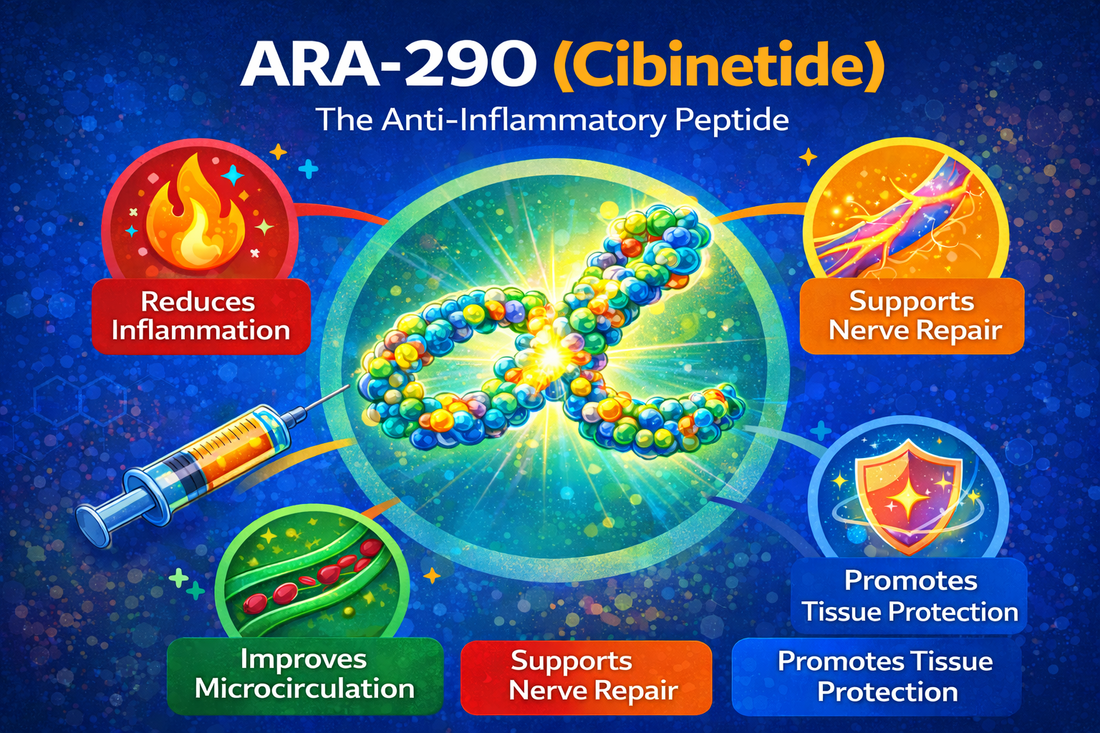
ARA-290 (Cibinetide): A Novel Peptide for Inflammation, Nerve Repair, and Tissue Protection
ARA-290, also known by its research name cibinetide, is one of the most intriguing peptides studied in the fields of neuroprotection, inflammation, and tissue repair. Unlike many peptides used for metabolic or cosmetic purposes, ARA-290 was developed from a deep understanding of cellular stress signaling and innate repair mechanisms.
What makes ARA-290 especially unique is that it is derived from erythropoietin (EPO) yet does not stimulate red blood cell production. This allows it to harness the protective and anti-inflammatory effects of EPO without the risks associated with increased hematocrit or thrombosis.
This article explains what ARA-290 is, how it works, what conditions it has been studied in, and how integrative medicine views its role in chronic inflammatory and neurologic conditions.
What Is ARA-290?
ARA-290 is a synthetic peptide derived from the tertiary structure of erythropoietin. It was engineered to selectively activate the innate repair receptor (IRR), a receptor complex involved in tissue protection and inflammation control.
Unlike full-length erythropoietin, ARA-290:
-
Does not bind the classical erythropoietin receptor responsible for red blood cell production
-
Does not increase hematocrit
-
Does not stimulate bone marrow erythropoiesis
Instead, it selectively activates anti-inflammatory and cytoprotective pathways.
Why ARA-290 Is Also Called Cibinetide
Cibinetide is the international nonproprietary name (INN) used in clinical research and pharmaceutical development. Both terms refer to the same molecule.
In scientific literature:
-
ARA-290 is commonly used in experimental and peptide discussions
-
Cibinetide is more frequently used in clinical trial publications
For clarity and consistency, both terms are often used interchangeably.
Understanding the Innate Repair Receptor (IRR)
The innate repair receptor is a heteromeric receptor complex composed of:
-
Erythropoietin receptor (EPOR)
-
β-common receptor (CD131)
This receptor is activated in response to:
-
Tissue injury
-
Hypoxia
-
Inflammation
-
Oxidative stress
Activation of the IRR triggers a cascade of protective signaling designed to:
-
Limit tissue damage
-
Reduce inflammation
-
Promote cellular survival
-
Support repair rather than scarring
ARA-290 was designed specifically to activate this receptor without activating erythropoiesis.
Key Biological Effects of ARA-290
1. Potent Anti-Inflammatory Signaling
ARA-290 suppresses pro-inflammatory cytokines, including:
-
TNF-α
-
IL-1β
-
IL-6
It also inhibits NF-κB signaling, a central driver of chronic inflammation.
Importantly, this effect is immunomodulatory, not immunosuppressive, meaning it calms excessive inflammation without shutting down immune defense.
2. Neuroprotection and Nerve Repair
ARA-290 has been extensively studied for its effects on:
-
Small fiber neuropathy
-
Diabetic neuropathy
-
Chemotherapy-induced nerve damage
-
Autonomic dysfunction
Mechanisms include:
-
Reduced neuroinflammation
-
Improved mitochondrial function in neurons
-
Enhanced nerve fiber survival
-
Restoration of sensory signaling
3. Protection Against Ischemic Injury
In preclinical models, ARA-290 protects tissues exposed to:
-
Hypoxia
-
Ischemia-reperfusion injury
-
Oxidative stress
This has implications for:
-
Cardiovascular health
-
Kidney protection
-
Neurovascular integrity
4. Endothelial and Microvascular Support
ARA-290 improves endothelial signaling and reduces microvascular inflammation. This is particularly relevant in conditions characterized by:
-
Capillary dysfunction
-
Impaired tissue perfusion
-
Chronic inflammatory injury
Conditions Studied in ARA-290 Research
Diabetic Neuropathy
One of the most studied applications of ARA-290 is diabetic neuropathy.
Clinical trials have shown:
-
Reduced neuropathic pain
-
Improved nerve fiber density
-
Better sensory function
Importantly, these benefits occurred without changes in hemoglobin or hematocrit.
Small Fiber Neuropathy
Small fiber neuropathy involves damage to unmyelinated nerve fibers responsible for pain, temperature, and autonomic function.
ARA-290 has demonstrated:
-
Regeneration of small nerve fibers
-
Improvement in autonomic symptoms
-
Reduced neuropathic pain
Sarcoidosis-Associated Neuropathy
In inflammatory conditions such as sarcoidosis, ARA-290 has been shown to:
-
Reduce nerve inflammation
-
Improve pain and fatigue
-
Support nerve recovery
Kidney Protection
Because erythropoietin signaling plays a role in renal protection, ARA-290 has been studied for:
-
Reducing renal inflammation
-
Limiting ischemic kidney injury
-
Preserving tubular function
Autoimmune and Inflammatory Conditions
Although not a classic autoimmune therapy, ARA-290’s ability to calm inflammatory signaling makes it relevant in conditions characterized by immune-mediated tissue injury.
Why ARA-290 Is Different from Erythropoietin
Erythropoietin:
-
Increases red blood cell production
-
Raises hematocrit
-
Increases thrombosis risk at high levels
ARA-290:
-
Does not affect red blood cells
-
Does not raise hematocrit
-
Does not increase clotting risk
This distinction makes ARA-290 suitable for chronic use in inflammatory and neurologic conditions, where EPO would be unsafe.
Integrative Medicine Perspective on ARA-290
From an integrative medicine standpoint, ARA-290 is not viewed as a stand-alone solution but as part of a broader tissue repair and inflammation-reduction strategy.
The goal is not symptom suppression, but restoration of cellular resilience.
Synergy with Gut Health and Immune Balance
Chronic inflammation and neuropathy are frequently driven by upstream factors such as:
-
Gut barrier dysfunction
-
Dysbiosis
-
Metabolic stress
Peptides like BPC-157 and KPV are often discussed alongside ARA-290 because they address:
-
Intestinal permeability
-
Mucosal inflammation
-
Immune signaling at the gut level
By reducing inflammatory load, these strategies may enhance the effectiveness of neuroprotective peptides.
Relationship to Mitochondrial Health
Nerve cells are highly dependent on mitochondrial function.
ARA-290 supports:
-
Mitochondrial integrity
-
Reduced oxidative stress
-
Improved cellular energy signaling
This makes it conceptually synergistic with mitochondrial-supportive interventions.
Inflammation Resolution vs Inflammation Suppression
A key advantage of ARA-290 is that it promotes inflammation resolution, not blanket suppression.
Resolution involves:
-
Turning off inflammatory signaling once repair is complete
-
Preserving immune surveillance
-
Preventing chronic immune activation
This distinction is central to integrative approaches to chronic disease.
Safety Profile of ARA-290
Clinical trials have demonstrated:
-
Excellent tolerability
-
No significant hematologic changes
-
No increased infection risk
-
No evidence of immunosuppression
Most adverse effects reported have been mild and transient.
Why ARA-290 Is of Interest in Chronic Disease
Many chronic diseases share common underlying mechanisms:
-
Persistent inflammation
-
Oxidative stress
-
Microvascular dysfunction
-
Impaired tissue repair
ARA-290 targets these shared upstream drivers, making it broadly relevant across conditions rather than disease-specific.
What ARA-290 Is Not
It is important to clarify what ARA-290 does not do:
-
It is not a painkiller
-
It is not an anabolic peptide
-
It does not stimulate red blood cell production
-
It does not suppress the immune system
Its effects are regulatory and restorative, not stimulatory.
Key Takeaways
-
ARA-290 (cibinetide) is derived from erythropoietin without erythropoietic effects
-
It activates the innate repair receptor
-
It reduces inflammation while preserving immune function
-
It supports nerve repair and tissue protection
-
It has been studied extensively in neuropathic and inflammatory conditions
-
It fits naturally into an integrative medicine framework
The Bigger Picture
ARA-290 represents a shift away from symptom-focused medicine toward cellular repair biology. Rather than blocking inflammatory signals indiscriminately, it helps the body complete the repair process and restore equilibrium.
This approach aligns closely with modern integrative and longevity-focused medicine.
Scientific References
-
Brines M, Cerami A. Emerging biological roles for erythropoietin in tissue protection. Nat Rev Mol Cell Biol.
-
Brines M, et al. ARA-290, a nonerythropoietic erythropoietin-derived peptide, reduces neuropathic pain. Proc Natl Acad Sci USA.
-
Heij L, et al. Cibinetide improves small fiber neuropathy in sarcoidosis. Mol Med.
-
Swartjes M, et al. Anti-inflammatory effects of ARA-290 in neuropathic pain. Pain.
-
Leist M, et al. Cytoprotective effects of erythropoietin signaling. Science.