


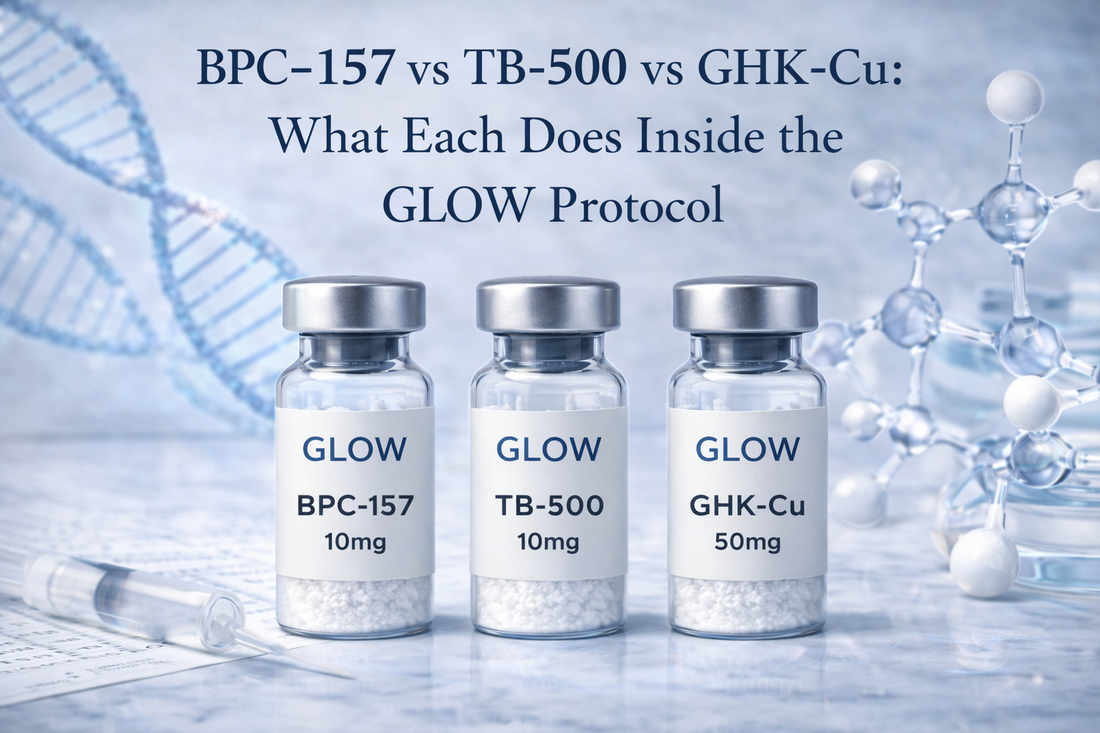
BPC-157 vs TB-500 vs GHK-Cu: What Each Does Inside the GLOW Protocol
Peptide therapy is often described as a set of individual compounds that can be swapped in and out like parts in a machine. That framing creates confusion, unrealistic expectations, and disappointing outcomes. In real biology, healing is not a single lever you pull. Healing is a coordinated cascade that depends on inflammation control, circulation, cell migration, collagen remodeling, and long-term tissue organization. When even one of those steps becomes rate-limiting, recovery slows and plateaus.
That is why protocol-based peptide therapy consistently outperforms single-peptide therapy. The GLOW protocol was built as a systems-level regenerative strategy, not as a marketing blend. It intentionally combines peptides with complementary actions so the body can move from injury and inflammation toward repair and resilience.
In this article, you will learn exactly what BPC-157, TB-500, and GHK-Cu do, why each peptide has limitations when used alone, and how their roles change when used inside the GLOW protocol. If you have tried single peptides without durable results, or if you want to understand why stacked therapy is different, this breakdown will give you a clear framework.
Why the GLOW Protocol Uses Multiple Peptides
The most common misconception in regenerative medicine is that healing happens in neat stages. Many people imagine a simple sequence: inflammation occurs, then tissues repair, then everything returns to normal. In reality, those processes run in parallel. Inflammation, repair signaling, angiogenesis, immune modulation, and remodeling occur at the same time. If one part of the network is under-supported, the entire network slows.
This is the central reason the GLOW protocol works: it supports multiple bottlenecks simultaneously. Single-peptide therapy tends to produce early improvement because it supports one bottleneck well. The plateau comes when the remaining bottlenecks become limiting. GLOW was designed to prevent that plateau.
Another reason multi-peptide protocols perform better is dosing efficiency. When a single peptide is used to push a single pathway aggressively, the body can respond with counter-regulation. Stacking peptides allows you to support the biology more broadly while avoiding the need to overdrive one pathway.
The Common Failure Pattern of Single-Peptide Therapy
Many patients describe the same story: they start a single peptide and feel improvement within days or weeks. Pain decreases, stiffness loosens, and sleep improves. Then progress slows. The injury remains sensitive. Training volume stalls. A familiar flare returns. The tissue feels better but not stable.
That pattern is not mysterious. It usually reflects one of these problems:
- Repair signaling is present, but blood supply is inadequate. Tissues can only rebuild when oxygen, amino acids, and micronutrients can reach the repair site.
- Inflammation is reduced, but immune balance is not restored. Excess inflammatory signaling continues to degrade tissue or disrupt healing.
- Cells migrate, but tissue organization is weak. Collagen may form, but it forms poorly, leading to reinjury risk.
- Short-term symptom relief replaces long-term remodeling. Pain reduction can occur before the tissue regains tensile strength.
The GLOW protocol addresses these failure points by assigning different peptides to different jobs. You are not asking one peptide to do everything. You are building a regenerative environment.
BPC-157: The Repair Accelerator
BPC-157 (Body Protection Compound-157) is a peptide derived from a protective protein found in gastric juice. It is widely used in regenerative settings because it supports tissue repair across multiple systems, particularly connective tissue. People often describe BPC-157 as a “healing peptide,” and that description is directionally correct, but it does not capture the nuance. BPC-157 does not merely “heal.” It pushes multiple repair mechanisms in ways that can change the trajectory of recovery.
What BPC-157 Does Mechanistically
While research continues to evolve, BPC-157 is commonly associated with several key actions relevant to healing:
- Angiogenesis support: It may promote the formation of new microvasculature, improving nutrient delivery to damaged tissues.
- Nitric oxide modulation: It is often discussed in relation to nitric oxide signaling, which can influence circulation and endothelial function.
- Oxidative stress reduction: It may reduce oxidative stress burden in injured tissues, which helps maintain a pro-repair environment.
- Connective tissue recovery: It is commonly used for tendon, ligament, and joint-support goals where recovery is slow.
- GI mucosal support: Because it is derived from gastric biology, it is frequently used in gut-lining support strategies.
Why BPC-157 Alone Often Plateaus
BPC-157 can accelerate the early stages of recovery, particularly when the limiting factor is poor circulation or slow tissue turnover. Yet BPC-157 alone may not fully solve:
- Long-term tissue organization: You can build tissue quickly without building it well. Durable healing requires correct remodeling.
- Immune-driven inflammation: If chronic inflammatory signaling remains active, repair continues to be disrupted.
- Functional movement patterns: Regeneration is not only chemical. Proper loading, stability, and neuromuscular control still matter.
When BPC-157 is used alone, many patients feel better, return to activity, and then discover the tissue is not yet resilient. That is not failure. That is incomplete programming.
BPC-157 Inside the GLOW Protocol
Inside GLOW, BPC-157 functions as the repair engine. Its job is to improve the environment for healing by supporting circulation, tissue recovery signaling, and the metabolic capacity of injured tissue. This is a foundational role: when blood supply and tissue viability improve, other peptides can produce more meaningful remodeling.
In plain terms: BPC-157 helps create the conditions under which rebuilding can happen efficiently.
TB-500: The Cellular Migration and Remodeling Director
TB-500 is a synthetic form of thymosin beta-4, a peptide associated with cell migration and tissue repair. Many people treat TB-500 as a “muscle repair peptide,” but its broader value is how it influences the logistics of healing. Healing requires cells to move, communicate, and organize. TB-500 is used because it supports those coordinated movements.
What TB-500 Does Mechanistically
TB-500 is commonly discussed in relation to these regeneration-supportive actions:
- Cell migration: Encouraging repair cells to reach the injury site efficiently.
- Cytoskeletal organization: Supporting actin-related dynamics that influence how cells move and structure tissue.
- Soft tissue recovery: Often used for muscle, fascia, and connective tissue remodeling goals.
- Fibrosis control support: In some frameworks, it is used to reduce dysfunctional scarring and improve tissue quality.
- Vascular growth support: TB-500 is frequently paired with agents that support angiogenesis because remodeling depends on blood supply.
Why TB-500 Alone Often Falls Short
TB-500 improves coordination, but coordination without fuel still fails. If circulation is limited, and the injury site is undernourished, cells cannot execute remodeling effectively. TB-500 alone may improve mobility, reduce stiffness, and enhance perceived recovery, yet it may not fully restore tensile strength.
Another issue is timing. TB-500 is often best used when you want to ensure that healing is organized. If inflammation remains excessive and unmanaged, the repair environment remains chaotic. That chaos makes remodeling less predictable.
TB-500 Inside the GLOW Protocol
Inside GLOW, TB-500 acts as the logistics coordinator. Its job is to support appropriate cellular migration and tissue remodeling so repair is not merely fast. Repair becomes functional and durable. When paired with BPC-157, the injury site receives improved support and circulation. When paired with GHK-Cu, the remodeling gains higher quality structural material.
In plain terms: TB-500 helps make the healing organized rather than improvised.
GHK-Cu: The Structural Rebuilder and Genetic Activator
GHK-Cu (Copper Tripeptide-1) is among the best-known regenerative peptides in human biology, particularly in skin and tissue remodeling. It naturally occurs in the body, and levels tend to decline with age. GHK-Cu is often associated with improved collagen and elastin production, tissue remodeling, and gene expression patterns that favor repair.
What GHK-Cu Does Mechanistically
GHK-Cu is widely used for structural regeneration goals because it is associated with:
- Collagen synthesis support: Collagen provides the scaffolding that gives tissue strength and integrity.
- Elastin support: Elastin contributes to flexibility and resilience.
- Tissue remodeling signals: GHK-Cu is often discussed as a “reset” signal that helps organize repair.
- Angiogenesis support: Improved tissue quality often follows improved vascular support.
- Gene expression influence: GHK-Cu has been associated with broad gene activation related to regeneration pathways.
Why GHK-Cu Alone Often Underperforms in Deep Injury Recovery
GHK-Cu can be impressive in skin quality and surface-level regeneration, yet deep tissue injuries and chronic inflammatory issues often require more groundwork. Structural rebuilding depends on:
- Adequate blood flow so repair materials can reach the site
- Proper cellular migration so rebuilding is organized
- Inflammation control so tissue is not continually degraded
When GHK-Cu is used alone, you may see improvements in texture and appearance, yet deeper functional recovery can lag when the rest of the repair system is not supported.
GHK-Cu Inside the GLOW Protocol
Inside GLOW, GHK-Cu is the architect. It supports rebuilding of tissue structure so healing is not temporary. When BPC-157 improves the environment and TB-500 improves cellular coordination, GHK-Cu can focus on producing better quality tissue with improved integrity.
In plain terms: GHK-Cu helps ensure the repaired tissue is stronger than it was before.
Why These Three Peptides Are Better Together
Each peptide addresses a different bottleneck. The advantage of GLOW is that it reduces the likelihood that recovery stalls at any single point. Think of it as a coordinated team:
- BPC-157: improves the repair environment and supports circulation and recovery signaling
- TB-500: organizes cellular migration and remodeling so healing is functional
- GHK-Cu: supports collagen and structural rebuilding to improve long-term strength
When used together, the body receives a comprehensive regenerative message. That message is not “feel better.” The message becomes “rebuild correctly.”
This is the same principle used in other areas of medicine. Complex problems rarely respond best to a single intervention. They respond best to coordinated strategies that address multiple mechanisms.
How the GLOW Protocol Solves the “Healing Plateau”
When someone uses a single peptide, the first improvement often comes from reducing friction in one area of healing. That is valuable, but it is not always sufficient. The plateau emerges when another bottleneck becomes dominant. GLOW reduces plateau risk by addressing multiple constraints simultaneously.
Common plateau scenarios include:
- The circulation bottleneck: repair stalls because nutrient delivery is insufficient
- The remodeling bottleneck: pain improves but stability does not return
- The inflammation bottleneck: repair attempts are repeatedly interrupted by flare cycles
- The structure bottleneck: collagen forms but remains disorganized and weak
GLOW is designed to support these simultaneously. That coordinated support is the reason patients often report that stacked protocols feel more complete than monotherapy.
GLOW in Real-World Recovery: What People Notice
While outcomes vary by individual, consistent themes appear when stacked regenerative strategies are used appropriately. People often notice improvements in:
- Recovery speed: soreness resolves faster and training consistency improves
- Range of motion: tissue compliance improves without the same tightness rebound
- Stability: joints feel more dependable during load
- Resilience: flare cycles become less frequent and less intense
- Confidence: movement feels safer, which improves adherence to rehab and training
The key is that the goal shifts from short-term symptom relief to long-term tissue resilience. That is what most people actually want.
Where GLOW Fits Clinically
The GLOW protocol is often discussed in contexts where healing is difficult, slow, or incomplete. Those contexts can include:
Musculoskeletal Injuries
- Tendonitis and tendinopathy
- Ligament sprains and chronic laxity patterns
- Overuse injuries in endurance and strength training
- Post-injury weakness and recurrent flare cycles
Regenerative Procedure Support
- Prolotherapy recovery support
- PRP recovery support
- Post-procedure tissue remodeling goals
Skin and Soft Tissue Repair Goals
- Improved collagen quality and tissue texture goals
- Support for recovery after dermatologic stressors
- Age-related decline in regeneration capacity
The best results occur when peptides are integrated into a broader plan that includes appropriate movement, adequate protein, sleep optimization, micronutrient sufficiency, and inflammation triggers addressed.
Why “Feeling Better” Is Not the Same as “Being Healed”
Pain relief can happen before healing is complete. In fact, that is one reason reinjury occurs. People return to activity when pain decreases, yet the tissue may not have regained structural integrity. The GLOW protocol is designed to support deeper remodeling so recovery is more durable.
A more useful definition of healing includes:
- Restored function under load
- Improved tissue resilience and tolerance
- Reduced frequency of flare cycles
- Improved movement confidence
- Reduced reinjury risk
When therapy supports all of these, it becomes truly regenerative.
Practical Decision Framework: Which Peptide Does What Inside GLOW?
If you want a simple framework, use this:
- BPC-157 improves the environment for repair and supports recovery signaling
- TB-500 supports organized cellular movement and remodeling so repair becomes functional
- GHK-Cu supports structural rebuilding and collagen organization for long-term integrity
The reason this matters is not academic. It prevents unrealistic expectations. It also helps people understand why single-peptide therapy can help yet still feel incomplete.
Safety and Medical Supervision
Peptides should be used under the supervision of a licensed medical professional trained in peptide therapy. Product quality, sterility, and appropriate patient selection matter. Dosing and cycling decisions should reflect individual goals, health history, medications, and risk factors.
This article is educational. It does not replace individualized medical guidance. If you are exploring peptide therapy, work with a qualified clinician who can help you build a plan that matches your physiology and goals.
Final Thoughts
The GLOW protocol works because it respects how biology actually heals. Healing is a network process. Single-peptide therapy often supports one part of that network well, then stalls when other constraints take over. By combining BPC-157, TB-500, and GHK-Cu, GLOW supports the repair environment, cellular coordination, and structural rebuilding simultaneously.
If you want faster recovery, stronger tissue, and more durable results, stacked therapy is often the more rational strategy. The goal is not short-term relief. The goal is long-term resilience.
Call to Action
If you have tried single peptides with incomplete results, or if you want a protocol designed for comprehensive healing rather than partial improvement, the GLOW approach may be a better fit.