



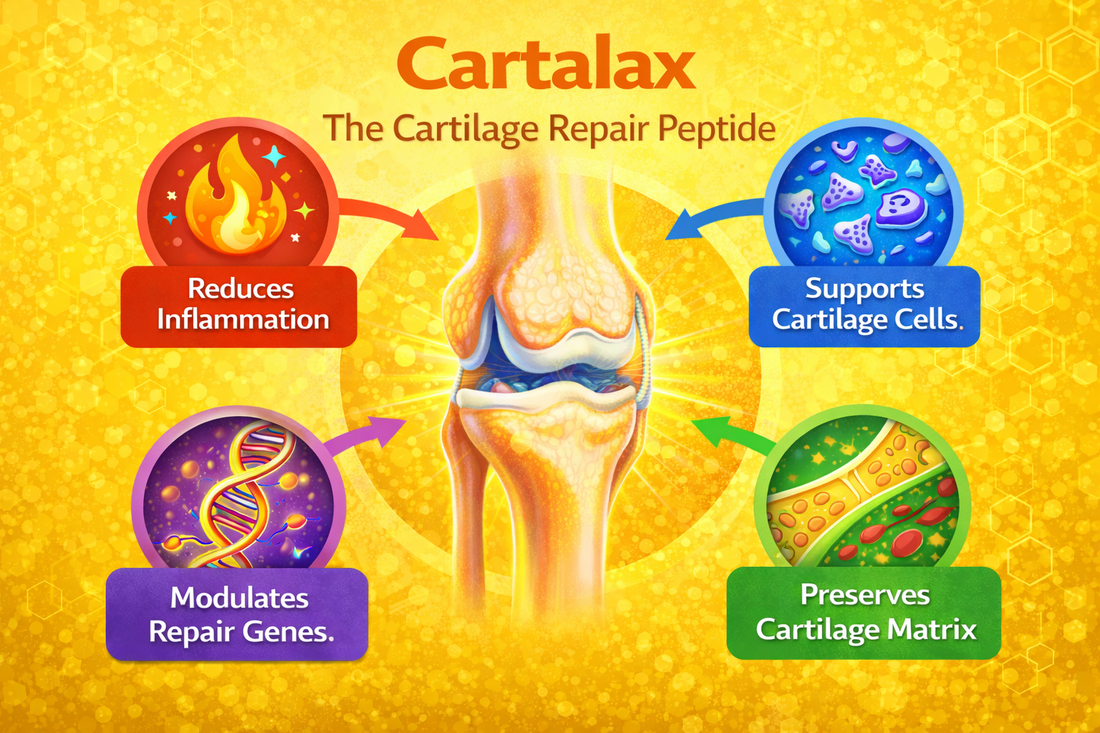
Cartalax: A Targeted Peptide for Cartilage Repair, Joint Health, and Degenerative Disease Prevention
Joint pain, stiffness, and degenerative arthritis affect hundreds of millions of people worldwide. While conventional medicine focuses primarily on symptom control through anti-inflammatory medications, injections, or surgery, these approaches rarely address the underlying biology of cartilage degeneration.
Cartilage is a unique tissue with limited blood supply, slow cellular turnover, and minimal intrinsic repair capacity. Once damaged, it often continues to deteriorate unless upstream signaling pathways are addressed.
This biological limitation has driven interest in tissue-specific peptides, including Cartalax, a peptide designed to support cartilage integrity, cellular signaling, and joint resilience at a molecular level.
This article explores what Cartalax is, how it works, why cartilage degeneration occurs, and how Cartalax fits into an integrative approach to joint and musculoskeletal health.
What Is Cartalax?
Cartalax is a synthetic peptide derived from cartilage-specific cytomedine research. Cytomedines are short peptides originally identified in animal tissues that act as organ- and tissue-specific signaling molecules.
Cartalax was developed to:
-
Target cartilage tissue
-
Support chondrocyte signaling
-
Regulate gene expression related to cartilage repair and maintenance
-
Reduce degenerative and inflammatory signaling within joints
Unlike systemic anti-inflammatory agents, Cartalax is designed to work at the cellular communication level, influencing how cartilage cells behave and respond to stress.
Understanding Cartilage Biology
To understand Cartalax, it is essential to understand why cartilage degeneration is so difficult to reverse.
Cartilage:
-
Has no direct blood supply
-
Relies on diffusion for nutrient delivery
-
Contains relatively few cells (chondrocytes)
-
Has low regenerative capacity
Chondrocytes are responsible for:
-
Producing collagen (primarily type II)
-
Producing proteoglycans such as aggrecan
-
Maintaining extracellular matrix structure
When chondrocytes become dysfunctional due to inflammation, mechanical stress, or aging, cartilage degradation accelerates.
Why Cartilage Degenerates
Several factors drive cartilage breakdown:
Chronic Inflammation
Inflammatory cytokines such as IL-1β and TNF-α stimulate enzymes that degrade cartilage matrix.
Mechanical Stress
Excessive joint loading, poor biomechanics, and prior injury accelerate wear.
Aging
With age, chondrocytes lose responsiveness to repair signals and shift toward catabolic activity.
Metabolic Dysfunction
Insulin resistance and systemic inflammation impair cartilage metabolism.
Oxidative Stress
Reactive oxygen species damage cartilage cells and matrix proteins.
Cartalax is designed to counter several of these mechanisms simultaneously.
Mechanism of Action: How Cartalax Works
1. Regulation of Chondrocyte Gene Expression
One of Cartalax’s most important effects is its influence on gene expression within cartilage cells.
Research suggests Cartalax:
-
Upregulates genes involved in cartilage matrix synthesis
-
Supports collagen and proteoglycan production
-
Downregulates genes associated with degeneration and inflammation
This gene-level modulation helps shift cartilage metabolism from breakdown toward preservation.
2. Reduction of Inflammatory Signaling
Cartalax has been shown to reduce inflammatory activity within cartilage tissue by:
-
Suppressing pro-inflammatory cytokine signaling
-
Reducing matrix metalloproteinase (MMP) activity
-
Supporting a more balanced inflammatory environment
This is particularly important in osteoarthritis, where inflammation drives progressive cartilage loss.
3. Support of Chondrocyte Survival
Chondrocyte apoptosis is a major contributor to cartilage thinning.
Cartalax supports:
-
Cellular resilience under inflammatory stress
-
Reduced apoptosis signaling
-
Improved cellular communication within cartilage
Preserving chondrocyte viability is essential for long-term joint health.
4. Promotion of Cartilage Homeostasis
Rather than forcing regeneration, Cartalax supports homeostasis, the balance between synthesis and degradation.
This distinction is critical because excessive stimulation can be just as harmful as insufficient repair.
Cartalax as a Cytomedine Peptide
Cartalax belongs to a broader class of peptides known as cytomedines, which include tissue-specific peptides for:
-
Thymus
-
Pineal gland
-
Liver
-
Brain
-
Cartilage
Cytomedines are unique because they:
-
Act in very small amounts
-
Influence cell signaling rather than acting as hormones
-
Target specific tissues based on peptide sequence
This specificity reduces systemic side effects.
Cartalax and Osteoarthritis
Osteoarthritis is characterized by:
-
Progressive cartilage loss
-
Low-grade chronic inflammation
-
Subchondral bone changes
-
Pain and stiffness
Cartalax addresses several aspects of osteoarthritis biology:
-
Reducing inflammatory signaling
-
Supporting cartilage matrix integrity
-
Preserving chondrocyte function
While it is not a cure, it aligns with a disease-modifying rather than symptom-masking approach.
Cartalax in Joint Injury and Recovery
After joint injury, cartilage often undergoes accelerated degeneration due to:
-
Inflammatory cascades
-
Altered biomechanics
-
Reduced nutrient diffusion
Supporting cartilage signaling early may help limit long-term damage.
Cartalax is conceptually important in:
-
Post-traumatic joint injury
-
Sports-related cartilage stress
-
Overuse syndromes
Integrative Medicine Perspective on Cartalax
From an integrative medicine standpoint, cartilage degeneration is rarely isolated.
Joint health reflects:
-
Inflammatory burden
-
Gut integrity
-
Metabolic health
-
Hormonal balance
-
Mechanical alignment
-
Nutrient availability
Cartalax fits into this framework as a cell-signaling support tool, not a stand-alone solution.
Synergy with Gut Health and Inflammation Control
There is growing recognition of the gut-joint axis.
Increased intestinal permeability and dysbiosis can:
-
Drive systemic inflammation
-
Worsen autoimmune and degenerative joint disease
-
Impair tissue repair signaling
Peptides such as BPC-157 and KPV are often discussed alongside Cartalax because they address upstream inflammatory drivers that affect joint health.
Relationship to Connective Tissue Peptides
Cartalax differs from peptides such as:
-
BPC-157 (broad tissue repair)
-
TB-500 (actin-based tissue repair)
Its specificity for cartilage signaling makes it complementary rather than redundant.
Cartalax and Aging Joints
With aging:
-
Chondrocyte responsiveness declines
-
Cartilage hydration decreases
-
Repair signaling diminishes
Cartalax’s gene-regulatory effects align with longevity-focused joint preservation, rather than short-term symptom relief.
What Cartalax Is Not
It is important to clarify limitations.
Cartalax is not:
-
A painkiller
-
A steroid
-
A replacement for joint alignment or physical therapy
-
A substitute for strength training or weight management
Its role is biological support, not mechanical correction.
Safety and Tolerability
Based on available research and clinical use patterns:
-
Cartalax is well tolerated
-
It is non-hormonal
-
It does not suppress immune function
-
It does not stimulate abnormal tissue growth
Its tissue specificity contributes to its favorable safety profile.
Integrating Cartalax into a Comprehensive Joint Strategy
A comprehensive approach to joint health includes:
-
Mechanical optimization
-
Weight management
-
Inflammation control
-
Nutrient sufficiency
-
Connective tissue support
-
Targeted signaling support
Cartalax addresses a gap in conventional care: cartilage-specific cellular communication.
The Bigger Picture: Disease Modification vs Symptom Control
Most conventional joint treatments focus on:
-
Pain reduction
-
Inflammation suppression
-
Structural replacement
Cartalax represents a shift toward disease modification, aiming to preserve tissue integrity and slow degeneration.
Key Takeaways
-
Cartalax is a cartilage-specific cytomedine peptide
-
It supports chondrocyte signaling and gene expression
-
It reduces inflammatory cartilage breakdown
-
It promotes cartilage homeostasis rather than overstimulation
-
It fits within an integrative joint health framework
-
It complements, but does not replace, mechanical and lifestyle interventions
Scientific References
-
Khavinson V, et al. Peptides and aging: tissue-specific regulation of gene expression. Neuro Endocrinol Lett.
-
Khavinson V, et al. Cytomedines and cartilage tissue regulation. Bull Exp Biol Med.
-
Goldring MB, Otero M. Inflammation in osteoarthritis. Curr Opin Rheumatol.
-
Loeser RF. Aging and osteoarthritis. Curr Opin Rheumatol.
-
Mobasheri A, et al. Chondrocyte biology and cartilage repair. Nat Rev Rheumatol.