



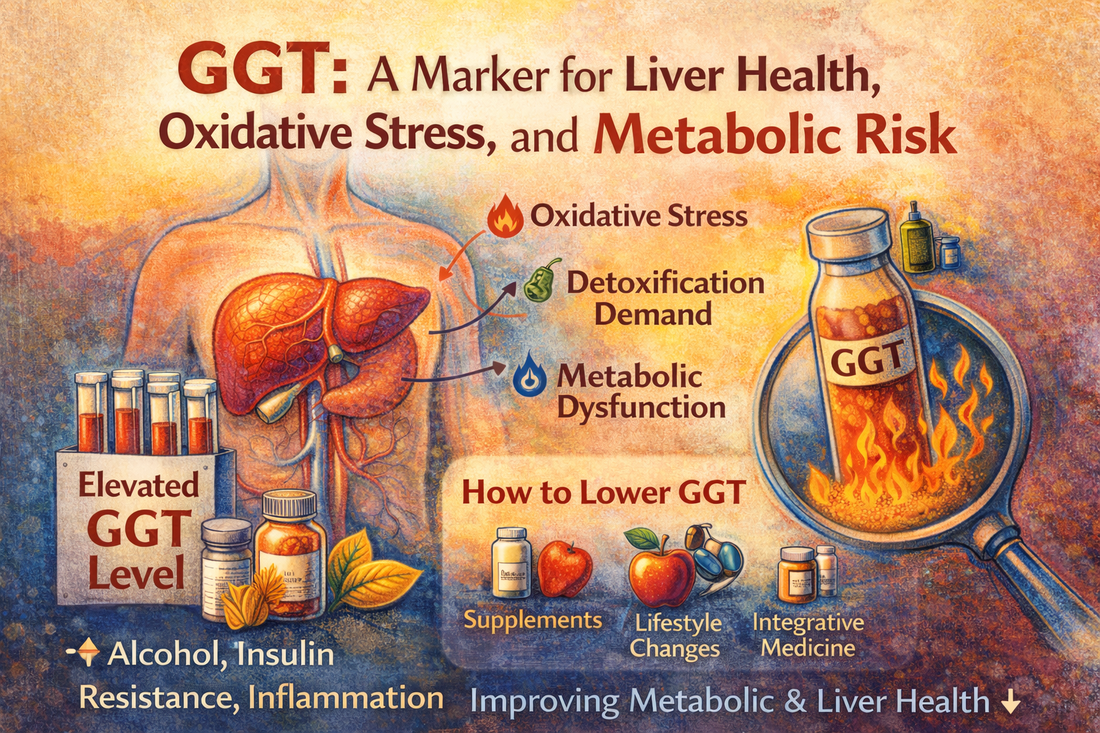
Understanding GGT: A Powerful Marker of Liver Health, Oxidative Stress, and Metabolic Risk
Gamma-glutamyl transferase (GGT) is one of the most misunderstood and underappreciated laboratory markers in modern medicine. Traditionally labeled as a “liver enzyme,” GGT is often ignored unless it is markedly elevated or paired with abnormal AST and ALT levels.
This narrow view misses the bigger picture.
In reality, GGT is not just a liver enzyme. It is a sensitive marker of oxidative stress, toxin burden, metabolic dysfunction, and long-term disease risk. When interpreted correctly, GGT offers insights that standard liver panels alone cannot provide.
This article explains what GGT is, why it rises, what it actually means for health, and how an integrative medicine approach can be used to lower elevated GGT and protect liver function.
What Is GGT?
Gamma-glutamyl transferase is an enzyme involved in glutathione metabolism. It plays a key role in the body’s antioxidant defense system.
GGT is found in many tissues, including:
-
Liver
-
Bile ducts
-
Kidneys
-
Pancreas
-
Intestines
-
Brain
Despite its widespread presence, the liver is the primary contributor to circulating GGT levels, which is why it is commonly associated with liver health.
The Role of GGT in Glutathione Recycling
To understand GGT, one must understand glutathione, the body’s most important endogenous antioxidant.
Glutathione:
-
Neutralizes free radicals
-
Supports detoxification
-
Protects mitochondria
-
Maintains cellular redox balance
GGT helps break down extracellular glutathione so its components can be recycled and transported back into cells.
When oxidative stress increases, the body demands more glutathione turnover. GGT rises as part of this adaptive response.
This is why elevated GGT often reflects oxidative stress rather than primary liver injury.
Why Do We Check GGT?
GGT is checked for several reasons, though many clinicians underutilize it.
1. Assessing Liver and Biliary Health
GGT is particularly sensitive to:
-
Bile duct irritation
-
Cholestasis
-
Alcohol-related liver stress
-
Medication-induced liver enzyme changes
It often rises before AST and ALT become abnormal.
2. Distinguishing Liver from Muscle Enzyme Elevations
When alkaline phosphatase (ALP) is elevated, GGT helps determine whether the source is:
-
Liver or bile ducts (GGT elevated)
-
Bone (GGT normal)
This distinction is clinically important.
3. Identifying Alcohol-Related Liver Stress
GGT is especially sensitive to alcohol intake, even at moderate levels. It often rises before imaging or symptoms reveal liver disease.
4. Assessing Oxidative Stress and Metabolic Risk
Beyond liver health, GGT correlates strongly with:
-
Insulin resistance
-
Metabolic syndrome
-
Cardiovascular disease
-
Type 2 diabetes
-
All-cause mortality
This makes it a valuable early warning marker.
What Is a Normal GGT Level?
Laboratory reference ranges vary, but typical upper limits are:
-
Men: ~50–65 U/L
-
Women: ~35–45 U/L
However, “normal” does not mean optimal.
From an integrative and preventive standpoint:
-
GGT below 20–25 U/L is often considered optimal
-
Risk begins to rise even within the reference range
Numerous studies demonstrate increased disease risk at GGT levels still labeled “normal” by standard labs.
What Causes GGT to Increase?
Elevated GGT is rarely caused by a single factor. It usually reflects cumulative stress on detoxification and antioxidant systems.
1. Alcohol Consumption
Alcohol is one of the most common drivers of elevated GGT.
Mechanisms include:
-
Increased oxidative stress
-
Glutathione depletion
-
Mitochondrial toxicity
-
Induction of liver detox enzymes
Importantly, GGT can rise even with moderate, socially acceptable alcohol intake, especially in genetically susceptible individuals.
2. Non-Alcoholic Fatty Liver Disease (NAFLD)
Fat accumulation in the liver creates:
-
Oxidative stress
-
Inflammatory signaling
-
Insulin resistance
GGT often rises early in NAFLD, sometimes before ALT becomes abnormal.
3. Insulin Resistance and Elevated Blood Sugar
GGT is tightly linked to glucose metabolism.
Chronic hyperglycemia and insulin resistance:
-
Increase oxidative stress
-
Deplete glutathione
-
Drive hepatic fat accumulation
Elevated GGT frequently precedes the diagnosis of type 2 diabetes.
4. Medication and Toxin Exposure
Many substances increase liver detoxification demand, including:
-
Acetaminophen
-
Statins
-
Anticonvulsants
-
Environmental toxins
-
Industrial chemicals
-
Persistent organic pollutants
The liver responds by increasing glutathione turnover, raising GGT.
5. Chronic Inflammation
Systemic inflammation increases oxidative burden and glutathione utilization. Conditions associated with elevated GGT include:
-
Obesity
-
Autoimmune disease
-
Chronic infections
-
Sleep apnea
6. Nutrient Deficiencies
Glutathione production depends on adequate availability of:
-
Glycine
-
Cysteine
-
Glutamate
-
B vitamins
-
Selenium
-
Magnesium
Deficiencies impair antioxidant capacity, forcing compensatory GGT elevation.
7. Cardiovascular and Metabolic Disease
Elevated GGT strongly correlates with:
-
Endothelial dysfunction
-
Atherosclerosis
-
Hypertension
-
Increased cardiovascular mortality
This relationship persists even after adjusting for alcohol intake.
Why GGT Is a Predictor of Disease Risk
Large epidemiologic studies have shown that GGT predicts:
-
Cardiovascular events
-
Stroke
-
Diabetes onset
-
Cancer risk
-
All-cause mortality
These associations remain significant even when:
-
AST and ALT are normal
-
Alcohol intake is low
-
Traditional risk factors are controlled
GGT reflects systemic oxidative stress, not just liver health.
GGT vs AST and ALT
AST and ALT reflect hepatocellular injury.
GGT reflects:
-
Detoxification demand
-
Oxidative stress
-
Glutathione turnover
A person can have:
-
Normal AST and ALT
-
Elevated GGT
-
Significant metabolic and cardiovascular risk
This is why GGT deserves independent attention.
An Integrative Medicine Approach to Lowering GGT
Lowering GGT is not about suppressing a number. It is about reducing oxidative stress, improving metabolic health, and restoring antioxidant capacity.
Lifestyle Interventions
Alcohol Reduction or Elimination
Even temporary abstinence can significantly lower GGT. In many cases:
-
GGT drops within 4–8 weeks
-
Oxidative stress markers improve
-
Insulin sensitivity improves
Weight Optimization
Weight loss reduces:
-
Hepatic fat
-
Inflammation
-
Insulin resistance
-
GGT levels
Even modest weight reduction has measurable effects.
Exercise
Regular physical activity:
-
Improves mitochondrial function
-
Enhances insulin sensitivity
-
Reduces oxidative stress
Both aerobic and resistance training are beneficial.
Sleep and Stress Management
Poor sleep increases oxidative stress and cortisol, indirectly raising GGT. Addressing sleep quality is foundational.
Nutritional Strategies
-
Reduce fructose and added sugars
-
Emphasize whole foods
-
Increase fiber intake
-
Support adequate protein for glutathione synthesis
-
Avoid ultra-processed foods
Supplement Support for Lowering GGT
N-Acetylcysteine (NAC)
NAC provides cysteine, the rate-limiting amino acid for glutathione synthesis. It is one of the most evidence-based supplements for lowering GGT.
Glycine
Glycine supports glutathione production and has anti-inflammatory effects.
Milk Thistle (Silymarin)
Silymarin:
-
Supports hepatocyte repair
-
Reduces oxidative damage
-
Improves liver enzyme profiles
Curcumin
Curcumin reduces:
-
Inflammation
-
Hepatic fat accumulation
-
Oxidative stress
Omega-3 Fatty Acids
Omega-3s reduce liver fat and improve insulin sensitivity, indirectly lowering GGT.
Magnesium
Magnesium deficiency worsens insulin resistance and oxidative stress. Repletion can improve liver markers.
Selenium
Selenium is required for glutathione peroxidase activity and antioxidant defense.
Medications That May Influence GGT
While medications are not prescribed solely to lower GGT, certain agents improve underlying drivers.
Insulin Sensitizers
Medications that improve glucose control often reduce GGT as metabolic health improves.
Lipid-Lowering Agents
Some lipid-lowering medications reduce liver fat and inflammation, indirectly lowering GGT, though others may transiently raise it.
Peptides and Emerging Therapies
Peptides are an emerging area of interest in metabolic and mitochondrial health. Potential mechanisms include:
-
Reducing oxidative stress
-
Improving mitochondrial efficiency
-
Supporting cellular repair
Clinical evidence is still evolving, and use should be cautious and individualized.
Monitoring Progress
When addressing elevated GGT, it is helpful to track:
-
GGT trends over time
-
AST and ALT
-
Fasting glucose and insulin
-
Lipid markers
-
Inflammatory markers
Improvement in GGT often precedes visible changes elsewhere.
Key Takeaways
-
GGT is more than a liver enzyme
-
It reflects oxidative stress, detox burden, and metabolic risk
-
Elevations often occur before overt disease
-
Alcohol, insulin resistance, and inflammation are major drivers
-
Integrative strategies can meaningfully lower GGT
The Bigger Picture
Elevated GGT is not a diagnosis. It is a signal.
It indicates that the body’s antioxidant and detoxification systems are under strain. Addressing that strain early can reduce long-term risk and support healthier aging.
Scientific References
-
Whitfield JB. Gamma glutamyl transferase. Crit Rev Clin Lab Sci.
-
Lee DH, et al. Gamma-glutamyltransferase and cardiovascular risk. Circulation.
-
Fraser A, et al. GGT as a predictor of metabolic syndrome. Diabetes Care.
-
Limdi JK, Hyde GM. Evaluation of abnormal liver function tests. Postgrad Med J.
-
Sies H. Glutathione and oxidative stress. Free Radic Biol Med.
-
Kunutsor SK, et al. GGT and mortality risk. Atherosclerosis.