


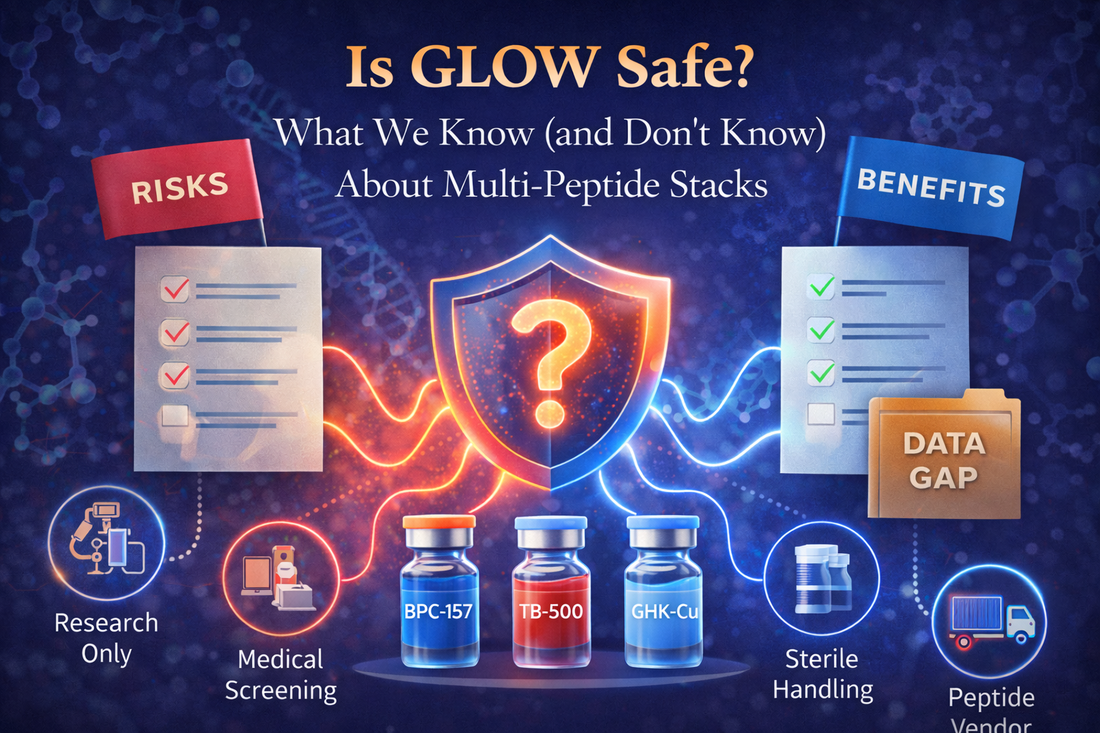
Is GLOW Safe? What We Know (and Don’t Know) About Multi-Peptide Stacks
Multi-peptide protocols are everywhere right now. Some are thoughtfully designed, clinically supervised, and used with clear goals. Others are thrown together online with unrealistic promises and no plan for screening, sourcing, monitoring, or safety. That contrast matters, because the most important question patients should ask is not, “Will this work?” The most important question is, “Is this safe for me?”
GLOW is a three-peptide protocol built around BPC-157, TB-500 (Thymosin Beta-4), and GHK-Cu (Copper Tripeptide-1). It is designed to support repair signaling, inflammation control, collagen remodeling, and tissue organization. It is not a “magic” solution. It is a strategy that aims to support biology in a coordinated way.
Still, “stacking” peptides raises valid safety questions. Combining compounds can change effects, risks, and expectations. Even when each individual peptide appears well tolerated, the combination deserves a separate, honest discussion.
This article will answer that question directly: Is GLOW safe? We will cover what we know from available data and clinical experience, what we do not know due to limitations in human trials, and what practical steps reduce risk the most.
If you want background on what the GLOW protocol is and how it is structured, start here: GLOW: BPC-157 + TB-500 + GHK-Cu .
First, the Most Honest Answer
There is no single universal answer, because “safe” depends on:
- your medical history and risk factors
- your current medications and conditions
- product quality and sterility
- dose selection and protocol duration
- whether the plan includes monitoring and follow-up
With that said, here is the practical reality:
- What we know: the individual peptides in GLOW are widely used in regenerative practice frameworks and are generally reported to be well tolerated when sourced appropriately and used under supervision.
- What we do not know: large, long-term, randomized human trials evaluating multi-peptide stacks like GLOW for specific indications are limited. That means long-term risk estimates are uncertain.
- What matters most: the greatest real-world safety risks usually come from poor sourcing, contamination, dosing errors, and skipping medical screening.
In other words, “Is it safe?” is often less about the concept of peptides and more about the execution of peptide therapy.
What Is a Multi-Peptide Stack, and Why Does Stacking Raise Safety Questions?
A multi-peptide stack is a protocol that uses more than one peptide to target different biological pathways. The intent is synergy: one peptide supports repair signaling, another supports tissue organization, and another supports structural rebuilding. Done correctly, a stack can reduce the need to “overpush” any single mechanism.
The reason stacking raises safety questions is simple: when you combine signals, you can also combine side effects, sensitivities, and unintended downstream effects. Even if each compound looks safe alone, the combination deserves a thoughtful plan.
Common fears people have about stacks
- “Is this too much for my body?”
- “Can peptides overstimulate growth pathways?”
- “Can I have an immune reaction?”
- “How do I know the product is clean?”
- “What if I have cancer risk or autoimmune disease?”
These are valid questions. A responsible clinic addresses them upfront rather than dismissing them.
What We Know About the Individual Components of GLOW
GLOW is built around three peptides that have different roles. Understanding safety starts with understanding what each does and what typical tolerance looks like.
BPC-157: Repair Signaling and Tissue Support
BPC-157 is commonly used in connective tissue and gut-focused regenerative frameworks. Most reported side effects in practice settings are mild and often relate to administration rather than systemic effects.
Read more here: BPC-157 Peptide Therapy .
TB-500 (Thymosin Beta-4): Cellular Migration and Remodeling Coordination
TB-500 is used to support tissue remodeling and recovery signals. In practice contexts, tolerance is generally reported as good when product quality is reliable.
Read more here: TB-500 (Thymosin Beta-4) Peptide Therapy .
GHK-Cu: Collagen Remodeling and Tissue Quality
GHK-Cu is a naturally occurring copper-binding peptide associated with collagen and tissue remodeling pathways. It has a long history in topical use and is increasingly discussed in regenerative frameworks.
Read more here: GHK-Cu Peptide Therapy .
What We Do Not Know (and Why That Matters)
Patients deserve clarity, not hype. The biggest scientific limitation with many peptides is not that they are “dangerous.” The limitation is that large-scale, long-duration human trials for specific outcomes are often limited.
That creates uncertainty in areas such as:
- long-term use beyond typical protocol durations
- rare side effects that require large sample sizes to detect
- interactions with complex medication regimens
- outcomes in special populations such as pregnancy, cancer history, or severe autoimmune disease
The right response to uncertainty is not fear, and it is not blind confidence. The right response is risk reduction: appropriate screening, conservative protocol design, and prioritizing product quality.
The Biggest Safety Risk Is Not the Stack. It Is the Source.
In real-world practice, the most common and preventable safety issue is poor sourcing. Many people purchase peptides from online “research” sellers that provide no reliable sterility assurance, no consistent potency verification, and no meaningful chain of custody.
This problem creates multiple risk layers:
- contamination with endotoxins, microbes, or unexpected compounds
- incorrect dosing from mislabeling or inconsistent concentration
- degradation due to poor storage or shipping
- unpredictable reactions that are not truly “side effects” but quality failures
If you want a clear explanation of why this matters, read: The Dangers of Buying Research Pharmacy Peptides .
If a person wants to minimize risk, sourcing is the first place to be strict. Not “mostly strict.” Strict.
Common Side Effects and Practical Safety Considerations
No clinician should promise “zero side effects.” A more useful promise is “predictable risk management.” Here are the most common issues seen in peptide protocols, including stacks:
1) Injection site reactions
Mild redness, itching, swelling, or tenderness can occur at the injection site. This is often due to technique, local histamine response, or irritant effects from reconstitution practices. It can also be a quality signal if reactions are unusually intense or persistent.
2) Headache or transient fatigue
Some patients report mild, short-lived symptoms during the first week as the body adjusts. Persistent symptoms should trigger a review of dose, hydration, sleep, and product quality.
3) Sleep disruption in sensitive individuals
While GLOW is not primarily a stimulant protocol, any change in inflammation signaling, pain levels, or recovery biology can shift sleep quality. Good coaching often resolves this by adjusting timing and recovery habits.
4) Skin changes with copper peptides
GHK-Cu is associated with tissue remodeling. Some people notice skin texture changes or temporary shifts in inflammation patterns. Clinician-guided dosing strategy and conservative starts reduce surprises.
5) Overtraining and “false confidence”
This is not a pharmacologic side effect. It is a behavioral side effect. If pain decreases quickly, people may increase training volume too fast. Tendons and ligaments remodel slowly, even when pain is improving. Smart programming matters.
Who Should Be More Cautious With GLOW?
A cautious approach is not a sign of weakness. It is how responsible medicine is practiced. Certain people should have extra screening, tighter monitoring, or alternative strategies:
- pregnancy or trying to conceive
- active cancer or recently treated cancer without oncology clearance
- uncontrolled autoimmune disease with high inflammatory burden
- severe allergic history or unpredictable reactions to injectables
- complex medication regimens that increase interaction concerns
- advanced liver or kidney disease that alters clearance and risk
“Cautious” does not automatically mean “no.” It means individualized planning.
Does Stacking Increase Risk Compared to Single-Peptide Therapy?
It can, but it does not have to. The answer depends on design.
A poorly designed stack can increase risk by creating too many simultaneous variables. If symptoms arise, you do not know which compound caused the issue. That is why clinicians often prefer conservative introductions and structured protocols rather than chaotic “add-ons.”
A well-designed stack can reduce risk by avoiding excessive dosing of any one peptide and by supporting multiple healing bottlenecks at once. When the biology is supported broadly, patients may need less aggressive signaling overall.
The most important safety feature of stacking is not the number of peptides. The most important safety feature is the presence of a plan.
How to Reduce Risk: A Practical Safety Checklist
If you want a clear safety framework, use this checklist:
1) Confirm the goal
- define what “success” means: pain reduction, function, training tolerance, stability
- set a reasonable timeline that matches connective tissue biology
2) Screen the person, not only the injury
- review medical history, medications, and contraindications
- consider baseline labs when clinically appropriate
3) Prioritize quality and sterility
- avoid unverified “research” sources
- use clinician-directed protocols with clear sourcing standards
4) Use conservative protocol strategy
- avoid unnecessary complexity
- avoid changing multiple variables every week
- do not treat peptides as a substitute for sleep, protein, and progressive loading
5) Monitor response and adjust
- track symptom trend, not only day-to-day fluctuations
- watch for injection site patterns
- escalate only when the response is stable
This approach reduces risk while improving outcomes, which is the point of responsible care.
What “Safe” Really Looks Like in Clinical Practice
Patients often want a simple yes or no. A better question is, “What does safe use look like?”
Safe peptide therapy generally includes:
- a clear indication and goal
- medical screening and individualized review
- high-quality sourcing and sterile handling
- protocol structure that prevents constant variable changes
- education on realistic timelines, especially for tendons and ligaments
- a plan for side effects, including what to stop and when
If these elements are missing, even “safe” compounds become higher risk in practice.
Bottom Line
Is GLOW safe? In a medically supervised, quality-controlled context with appropriate screening and protocol design, it is generally viewed as a reasonable regenerative strategy and is commonly reported as well tolerated. Still, long-term human data on multi-peptide stacks remains limited, and that uncertainty should be respected.
The greatest avoidable dangers come from poor sourcing and unsupervised use. If you want to reduce risk, start there.
For deeper reading on the protocol and each component: GLOW overview, BPC-157, TB-500, and GHK-Cu.
Call to Action
If you are considering GLOW or any multi-peptide stack, do not rely on forum advice or vendor claims. Work with a qualified clinician who can evaluate your risks, select appropriate protocols, and ensure product quality. A responsible plan improves outcomes and reduces preventable complications.
Start with education and clinic-directed guidance through Revolution Health.