


KLOW Peptide Blend: A Comprehensive Approach to Healing, Inflammation Control, and Tissue Regeneration
Peptide therapy has rapidly emerged as one of the most promising frontiers in regenerative and functional medicine. Rather than masking symptoms, peptides work at the cellular signaling level, directing the body toward repair, balance, and restoration. Among the most advanced formulations in this space is KLOW, a precision-formulated peptide blend that combines four well-studied regenerative peptides—GHK-Cu, KPV, BPC-157, and TB500—into a single synergistic system.
KLOW is not a single-purpose peptide. It was designed to address inflammation, tissue damage, impaired healing, and cellular dysfunction simultaneously, making it uniquely suited for patients dealing with chronic inflammation, injury recovery, gut dysfunction, and accelerated aging processes.
This article explores the science behind KLOW, the role of each peptide in the blend, how they work together, and why this combination represents a next-generation approach to regenerative medicine.
Why Peptide Blends Matter
Single peptides can be powerful, but biological systems rarely operate through one pathway alone. Injury, inflammation, and degeneration involve:
-
Immune dysregulation
-
Oxidative stress
-
Impaired blood flow
-
Defective collagen remodeling
-
Disrupted cellular migration
-
Chronic inflammatory signaling
Peptide blends allow clinicians to address multiple mechanisms at once, reducing therapeutic gaps and improving outcomes.
KLOW was formulated with this principle in mind.
What Is KLOW?
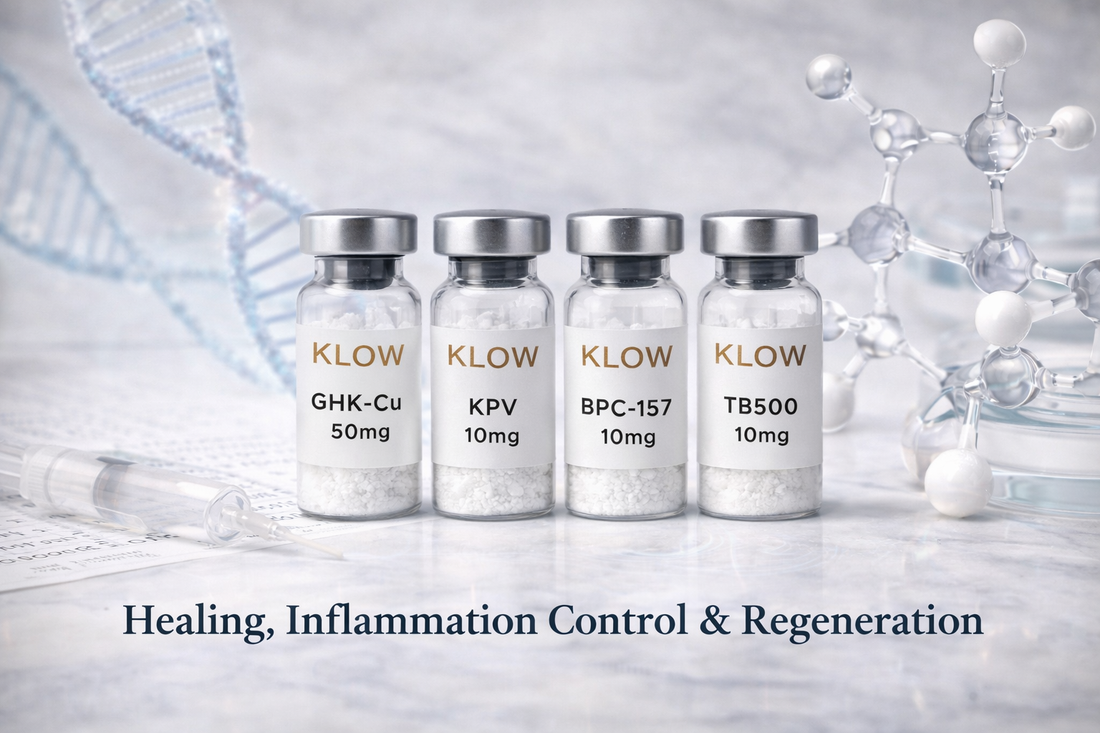
KLOW is a precision-engineered peptide blend containing:
-
GHK-Cu (50 mg)
-
KPV (10 mg)
-
BPC-157 (10 mg)
-
TB500 (10 mg)
Each peptide targets a distinct but complementary biological pathway. When combined, they create a coordinated regenerative signal that promotes healing across skin, muscle, connective tissue, gut lining, and vascular systems.
The Four Peptides That Power KLOW
1. GHK-Cu: The Master Regenerative Signal
GHK-Cu (Copper Tripeptide-1) is one of the most extensively studied regenerative peptides in human biology. Naturally present in plasma, saliva, and urine, its levels decline with age, correlating with slower healing and visible tissue degeneration.
Key Actions of GHK-Cu
-
Stimulates collagen and elastin synthesis
-
Promotes angiogenesis (new blood vessel formation)
-
Activates genes associated with tissue remodeling
-
Enhances wound healing
-
Improves skin firmness, thickness, and elasticity
GHK-Cu has been shown to influence thousands of genes, many of which are involved in repair, anti-inflammation, and antioxidant defense. This makes it foundational for skin regeneration, muscle recovery, and vascular health.
Within KLOW, GHK-Cu serves as the architect, signaling tissues to rebuild and remodel correctly.
2. KPV: Immune Modulation and Inflammation Control
KPV is a tripeptide derived from α-melanocyte-stimulating hormone (α-MSH). Its primary role is immune regulation, particularly within epithelial and mucosal tissues.
Key Actions of KPV
-
Downregulates pro-inflammatory cytokines
-
Reduces NF-κB signaling
-
Promotes immune tolerance and balance
-
Supports gut lining integrity
-
Calms epithelial inflammation
KPV is especially valuable in conditions involving chronic inflammation, whether localized (such as skin or joint inflammation) or systemic (such as gut-driven immune activation).
In KLOW, KPV acts as the fire suppressor, preventing excessive inflammatory signaling that would otherwise impair healing.
3. BPC-157: The Repair Accelerator
BPC-157 (Body Protection Compound-157) is derived from a naturally occurring protein found in gastric juice. It has gained significant attention for its profound effects on connective tissue healing.
Key Actions of BPC-157
-
Enhances angiogenesis
-
Reduces oxidative stress
-
Accelerates tendon and ligament repair
-
Supports gastrointestinal mucosal healing
-
Protects tissues from stress-related damage
BPC-157 is unique in its ability to promote healing even in poorly vascularized tissues, such as tendons and ligaments. It also demonstrates protective effects against inflammatory and oxidative injury.
Within KLOW, BPC-157 functions as the repair engine, speeding recovery while reducing tissue breakdown.
4. TB500: Cellular Migration and Tissue Remodeling
TB500 is a synthetic form of thymosin beta-4, a peptide involved in cellular movement and repair processes.
Key Actions of TB500
-
Promotes cell migration to injury sites
-
Enhances muscle fiber regeneration
-
Supports angiogenesis
-
Improves flexibility of connective tissues
-
Reduces recovery time following trauma
TB500 excels at coordinating how cells move and organize during healing, making it essential for proper tissue remodeling rather than scar formation.
In KLOW, TB500 acts as the logistics coordinator, ensuring repair cells arrive where they are needed.
Why KLOW Works Better Together Than Alone
Each peptide in KLOW is effective independently, but their synergy is where the formulation truly excels.
-
GHK-Cu signals regeneration
-
KPV controls inflammatory excess
-
BPC-157 accelerates repair
-
TB500 optimizes cellular coordination
This combination allows tissues to heal faster, stronger, and more completely than any single peptide could accomplish alone.
Clinical Applications of KLOW
KLOW may be considered in patients dealing with:
Musculoskeletal Injuries
-
Tendonitis
-
Ligament strains
-
Muscle tears
-
Post-surgical recovery
Chronic Inflammatory Conditions
-
Joint inflammation
-
Autoimmune-associated tissue damage
-
Overuse injuries
Gastrointestinal Healing
-
Increased intestinal permeability
-
Inflammatory gut conditions
-
Post-infectious gut dysfunction
Skin and Soft Tissue Repair
-
Accelerated aging
-
Poor wound healing
-
Post-procedure recovery
Systemic Recovery
-
Overtraining syndrome
-
Chronic stress-related tissue breakdown
-
Slow recovery from illness or injury
KLOW in a Functional Medicine Framework
From a functional and integrative perspective, KLOW aligns with key principles:
-
Address root causes
-
Support innate repair mechanisms
-
Reduce inflammatory burden
-
Optimize cellular communication
Rather than forcing outcomes, KLOW restores signaling pathways that allow the body to heal itself more effectively.
Safety and Quality Considerations
Peptides must be sourced from high-quality, rigorously tested manufacturing environments. Purity, sterility, and accurate dosing are essential, particularly when working with injectable peptide blends.
KLOW should be used under the supervision of a licensed medical professional trained in peptide therapy. These peptides are not FDA-approved for disease treatment and are intended for research and educational purposes.
Who Is a Good Candidate for KLOW?
KLOW may be appropriate for individuals who:
-
Have persistent inflammation impairing recovery
-
Are not responding to conventional therapies
-
Want regenerative support without harsh pharmaceuticals
-
Need multi-tissue healing support
-
Prefer biologically intelligent therapies
The Future of Regenerative Peptide Blends
KLOW represents the evolution of peptide therapy—from single-compound experimentation to purpose-driven, synergistic formulations. As understanding of cellular signaling advances, blends like KLOW will likely become foundational tools in regenerative medicine.
Scientific References
-
Pickart L, et al. The human tripeptide GHK-Cu in prevention of oxidative stress and aging. Biogerontology.
-
Luger TA, et al. α-MSH and immune modulation. Ann N Y Acad Sci.
-
Sikiric P, et al. BPC-157 and tissue repair mechanisms. Curr Pharm Des.
-
Goldstein AL, et al. Thymosin beta-4 and tissue regeneration. Ann N Y Acad Sci.
-
Szabo S, et al. Cytoprotective peptides and gut healing. Dig Dis Sci.