


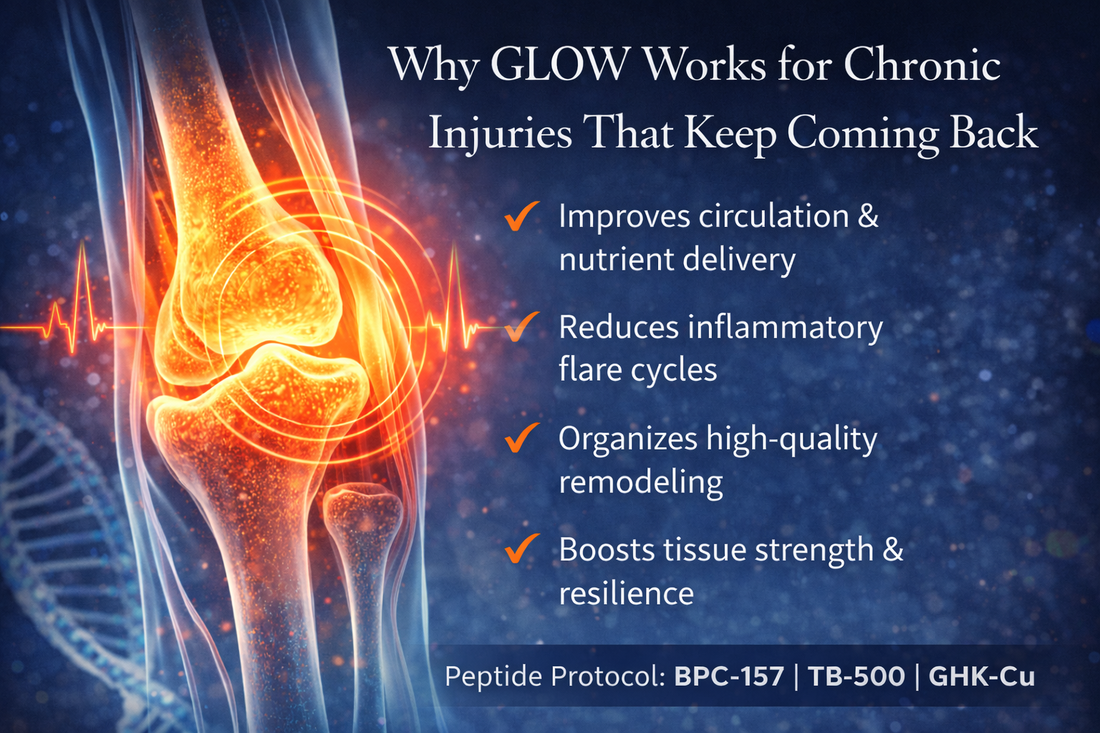
Why GLOW Works for Chronic Injuries That Keep Coming Back
Chronic injuries rarely fail to heal because the body is incapable of repair. Most chronic injuries fail to heal because the environment around the injury never becomes favorable for durable remodeling. Symptoms may improve, yet the tissue remains fragile. Activity resumes. The same area flares again. Then the cycle repeats.
This pattern is common with tendinopathy, ligament sprains that never fully stabilize, joint capsule irritation, and “mystery” pain that improves with rest but returns with loading. Many people interpret these relapses as bad luck. In reality, recurrent injury is usually a sign of an incomplete healing program.
The GLOW peptide protocol was designed for these exact situations. Instead of relying on a single peptide to do everything, GLOW supports the biology of recovery through complementary mechanisms: improving the repair environment, coordinating tissue remodeling, and rebuilding structural integrity. That combination matters when a tissue has been inflamed, under-perfused, and mechanically stressed for months or years.
This article explains why chronic injuries persist, what causes repeated flare cycles, and how GLOW supports recovery at the cellular level—especially when conventional approaches have produced partial or temporary results.
What Makes an Injury “Chronic”?
Chronic injury is not always a matter of time. It is usually a matter of tissue behavior. A tissue becomes chronic when it remains stuck in a loop of irritation, incomplete repair, and recurrent breakdown. Pain is often the only visible symptom, but underneath, several biological issues tend to coexist.
Common biological features of chronic injury
- Microvascular limitation: the tissue is under-perfused, which slows nutrient delivery and waste removal
- Inflammatory persistence: cytokine signaling stays elevated and disrupts remodeling
- Disorganized collagen: collagen exists, but it is poorly aligned, weak, or prone to reinjury
- Mechanical mismatch: loads exceed tissue capacity due to weakness, compensation, or instability
- Neurogenic sensitivity: irritated tissues and nerves amplify pain signals even when imaging is “normal”
In other words, chronic injuries do not usually need one intervention. They need a coordinated strategy that addresses multiple constraints at once.
Why Conventional Approaches Often Produce Temporary Relief
Rest reduces symptoms because it reduces mechanical stress. Anti-inflammatories reduce symptoms because they dampen inflammatory signaling. Physical therapy improves symptoms when it increases tissue capacity and motor control. These are all valuable tools. The problem is that many chronic injuries involve structural deficits that require deeper remodeling than symptom management can provide.
Temporary relief becomes common when one or more of these issues remains unaddressed:
- Blood flow remains limited, which slows repair
- Inflammation remains reactive, which disrupts collagen rebuilding
- Collagen remodeling remains incomplete, which leaves the tissue weak
- Stability remains impaired, which keeps load distribution dysfunctional
This is where peptide protocols can be useful. The goal is not to replace rehab. The goal is to improve biology so rehab can succeed.
What Is GLOW?
GLOW is a stacked peptide protocol that supports tissue repair by combining three regenerative peptides with complementary actions:
- BPC-157 to support repair signaling and tissue recovery environment
- TB-500 (Thymosin Beta-4) to support cellular migration and coordinated remodeling
- GHK-Cu to support collagen remodeling and long-term structural integrity
Chronic injury is rarely a single-pathway problem. GLOW was built to support multiple pathways in parallel, which reduces the common “healing plateau” seen with single-peptide therapy.
The Cellular Problem in Chronic Injury: The Tissue Never Gets the Right Message
A useful way to think about chronic injury is that the tissue is trapped between two competing signals: “repair” and “protect.” When a tissue has been repeatedly stressed, it often behaves as if it is still under threat. That behavior favors inflammation, guarding, stiffness, and pain sensitivity.
To move out of that protective state, the tissue needs consistent signals that support:
- adequate circulation and nutrient delivery
- controlled inflammatory signaling
- organized cell migration into damaged areas
- high-quality collagen synthesis and alignment
- progressive mechanical loading without repeated flare cycles
This is where GLOW fits. Each component supports a different part of this transition.
BPC-157: Supporting the Repair Environment When Healing Has Stalled
Chronic injuries often exist in tissues with limited blood flow and repeated oxidative stress. When a tissue is under-perfused, the body has difficulty delivering the building blocks of repair. That limitation is particularly important in tendons, ligaments, and joint capsule tissue.
BPC-157 is commonly used to support the repair environment through mechanisms frequently discussed in relation to:
- microvascular support, which helps delivery of oxygen and nutrients
- recovery signaling, which encourages transition from breakdown to rebuilding
- oxidative stress moderation, which supports healthier tissue conditions
- systemic inflammation influence, especially when gut integrity contributes to flare cycles
In practical terms, BPC-157 helps prepare the tissue to respond. When the environment improves, other remodeling signals become more effective.
TB-500: Improving Remodeling Quality and Reducing “Scar-Style” Healing
Many chronic injuries involve tissue that has healed in a dysfunctional way. Collagen may have formed, but the remodeling quality is poor. The tissue becomes stiff, brittle, and prone to flare cycles. People often interpret this as weakness, but it is more accurate to call it disorganized remodeling.
TB-500 is frequently used because organized remodeling requires coordinated cell migration and tissue rebuilding dynamics. TB-500 is commonly discussed for its role in:
- cell migration support, moving repair cells where they are needed
- remodeling coordination, promoting functional organization of tissue
- soft tissue recovery, supporting healthier tissue glide and flexibility
- recovery support, especially after repeated strain or trauma
Within GLOW, TB-500 helps shift remodeling away from chaotic rebuilding and toward a more functional tissue pattern.
GHK-Cu: Rebuilding Collagen Integrity So the Injury Stops Returning
Chronic injuries persist when tissue capacity remains below the demands placed on it. You can reduce pain and still have inadequate tensile strength. That mismatch is why reinjury occurs after activity resumes.
GHK-Cu is used in regenerative strategies because connective tissue depends on collagen quality. Tendons, ligaments, fascia, and joint capsules rely on well-organized collagen for strength and resilience.
GHK-Cu is often discussed in relation to:
- collagen remodeling support, improving the structural scaffold of tissue
- elasticity and resilience, which helps tissue tolerate load
- long-term integrity, reducing relapse risk
- age-related regenerative decline, supporting signaling that wanes over time
Inside GLOW, GHK-Cu functions as the structural builder. It supports the quality of the repair so the tissue is less likely to fail during real-life loading.
Why GLOW Can Feel Different Than “Just Taking a Peptide”
People often expect peptide therapy to behave like a pain reliever. That is the wrong expectation. When peptide therapy works well, it feels like capacity improves. The tissue tolerates more. Flare cycles diminish. Recovery becomes more predictable. That pattern happens because multiple bottlenecks are being addressed together.
GLOW is not designed to chase symptoms. It is designed to support:
- better circulation and tissue environment
- more organized remodeling
- stronger collagen structure and resilience
- reduced relapse risk under load
This is why protocol-based therapy often outperforms monotherapy in chronic injuries.
Common Scenarios Where GLOW Can Be Considered
A clinician may consider a protocol like GLOW in scenarios such as:
- tendinopathy that improves but never resolves
- recurrent sprains and ligament strains
- joint capsule irritation with persistent instability symptoms
- slow recovery after repetitive strain from training or work
- post-procedure remodeling support after prolotherapy or PRP
Candidate selection matters. Chronic pain can have multiple drivers, including nerve irritation, metabolic inflammation, and biomechanical compensation. A qualified clinician should evaluate the full context before recommending peptide therapy.
Why Peptide Quality and Sourcing Matter
Peptides should be sourced and used under medical supervision. Purity, sterility, and dosing accuracy matter. Inconsistent or contaminated products increase risk and reduce the likelihood of meaningful outcomes.
If you want a detailed explanation of the risks tied to low-quality sources, read: Dangers of Buying Research Pharmacy Peptides .
What Improves Outcomes While Using GLOW
Peptides support biology, but they do not replace mechanics. The best outcomes occur when peptide therapy is paired with a complete plan that addresses load, recovery, and inflammation triggers.
Practical supports that improve long-term results
- Progressive loading: structured strengthening that increases capacity gradually
- Movement quality: correcting compensation patterns that overload tissue
- Adequate protein: collagen remodeling requires amino acids
- Sleep optimization: recovery signaling deteriorates when sleep is poor
- Metabolic support: insulin resistance and systemic inflammation impair healing
When these elements align, the tissue receives both the biochemical support and the mechanical signal required for durable remodeling.
Final Thoughts
Chronic injuries persist when the tissue never exits the cycle of irritation and incomplete remodeling. Many people experience temporary relief, yet the underlying structural deficit remains. That deficit reappears as soon as load increases.
The GLOW protocol supports recovery by addressing multiple constraints at once: improving the repair environment (BPC-157), coordinating remodeling (TB-500), and rebuilding collagen integrity (GHK-Cu). When combined with appropriate loading and recovery strategy, this systems-based approach can improve long-term resilience and reduce relapse risk.
Call to Action
If you have a chronic injury that keeps returning, it may be time to stop chasing temporary fixes and start supporting durable remodeling. Schedule a consultation with a clinician trained in peptide therapy to determine whether the GLOW protocol aligns with your injury history, goals, and recovery plan.
For deeper reading on each peptide, you can review: BPC-157, TB-500, and GHK-Cu.